
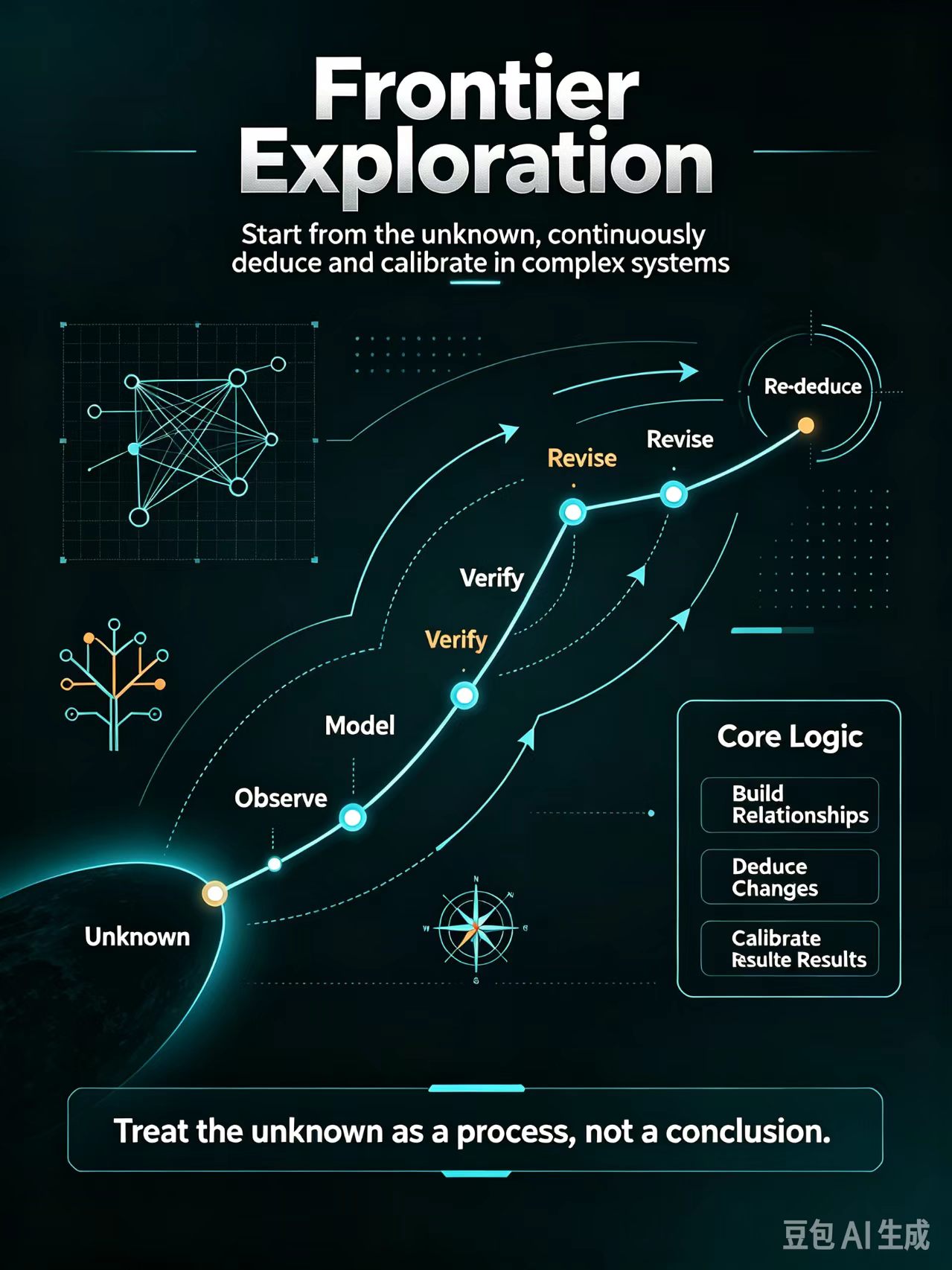
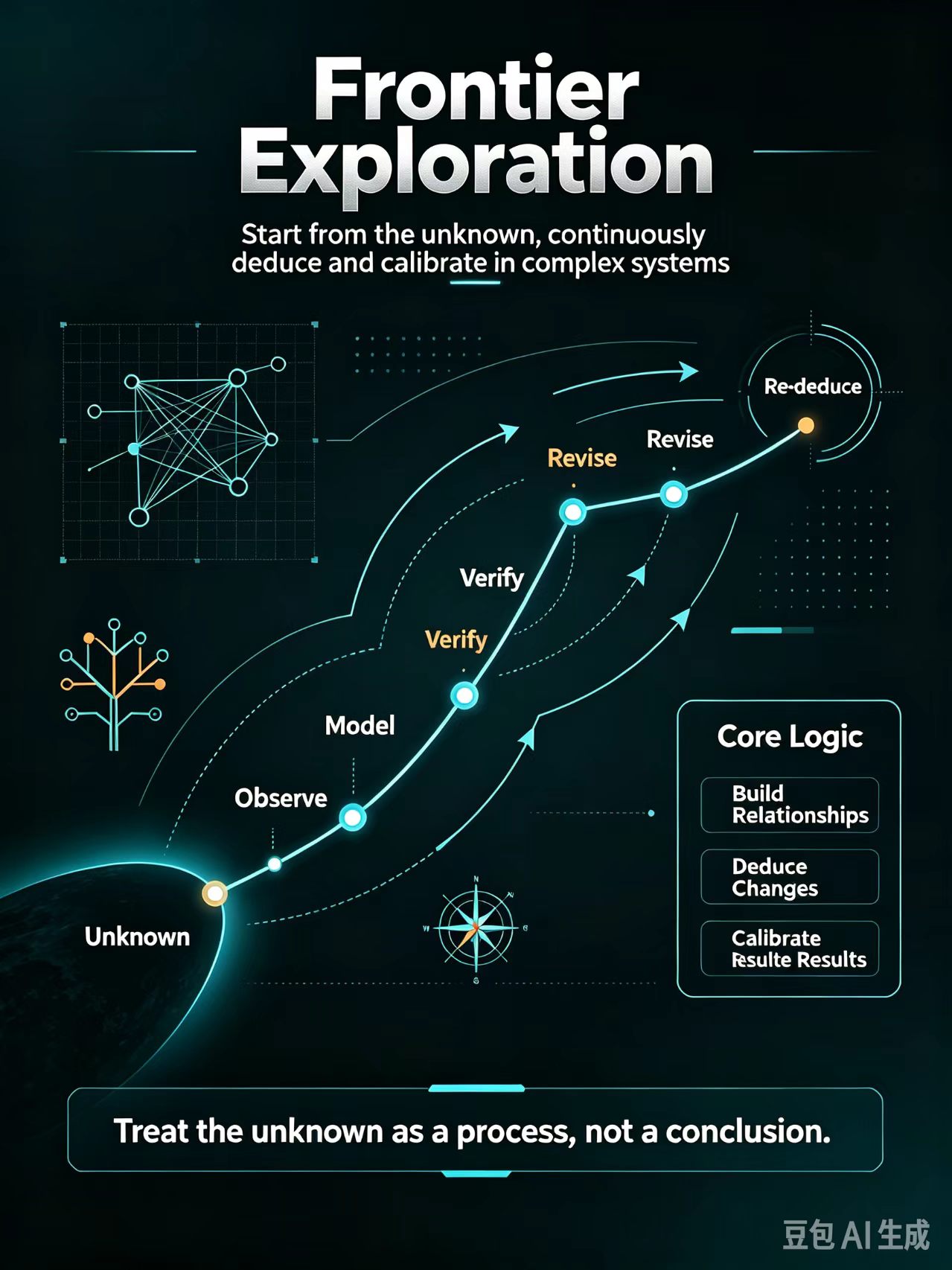
Frontier Exploration
Timestamp: 12:41, November 10, 2026 (Beijing Time, UTC+8)
This paper addresses not a single disorder of desire, but the shared underlying structure behind all desires. Appetite, immune response, wealth pursuit, addiction, and stage excitement differ in form, yet they follow identical dynamic principles. Unpacking this structure allows humans to shift from being driven by impulses to taking command of themselves.
I. Argument: The Reward Circuit as an Amplifier
Nearly all human behaviors, despite outward differences, rely on the same regulatory mechanism at the neuroendocrine level: the reward circuit, with dopamine as its core signaling carrier. When a condition favorable to survival occurs, the system releases positive signals, generating pleasure; when harmful conditions arise, negative signals are triggered to drive avoidance. This mechanism operates outside conscious awareness, as a fundamental instruction embedded in organisms through evolution.
It is critical to state: the reward circuit itself is neither good nor evil. It functions as an amplifier, not a balance scale. It contains no built-in upper limit, and only serves to amplify signals. Whatever input it receives, it returns amplified drive, and encodes the intensity, scenario and rhythm of the stimulus into future expectations. Without an inherent stop mechanism, it tends to stack repeated valid stimuli, until the system collapses under its own amplified feedback.
The variable separating amplification and loss of control is the threshold. The threshold determines whether a given stimulus can still evoke the same sensation. Once the threshold rises, the baseline of human behavior shifts upward, and it rarely falls back automatically. Grasping this variable illuminates all related phenomena.
II. Operating Mechanism: Four Stages of Dysregulation
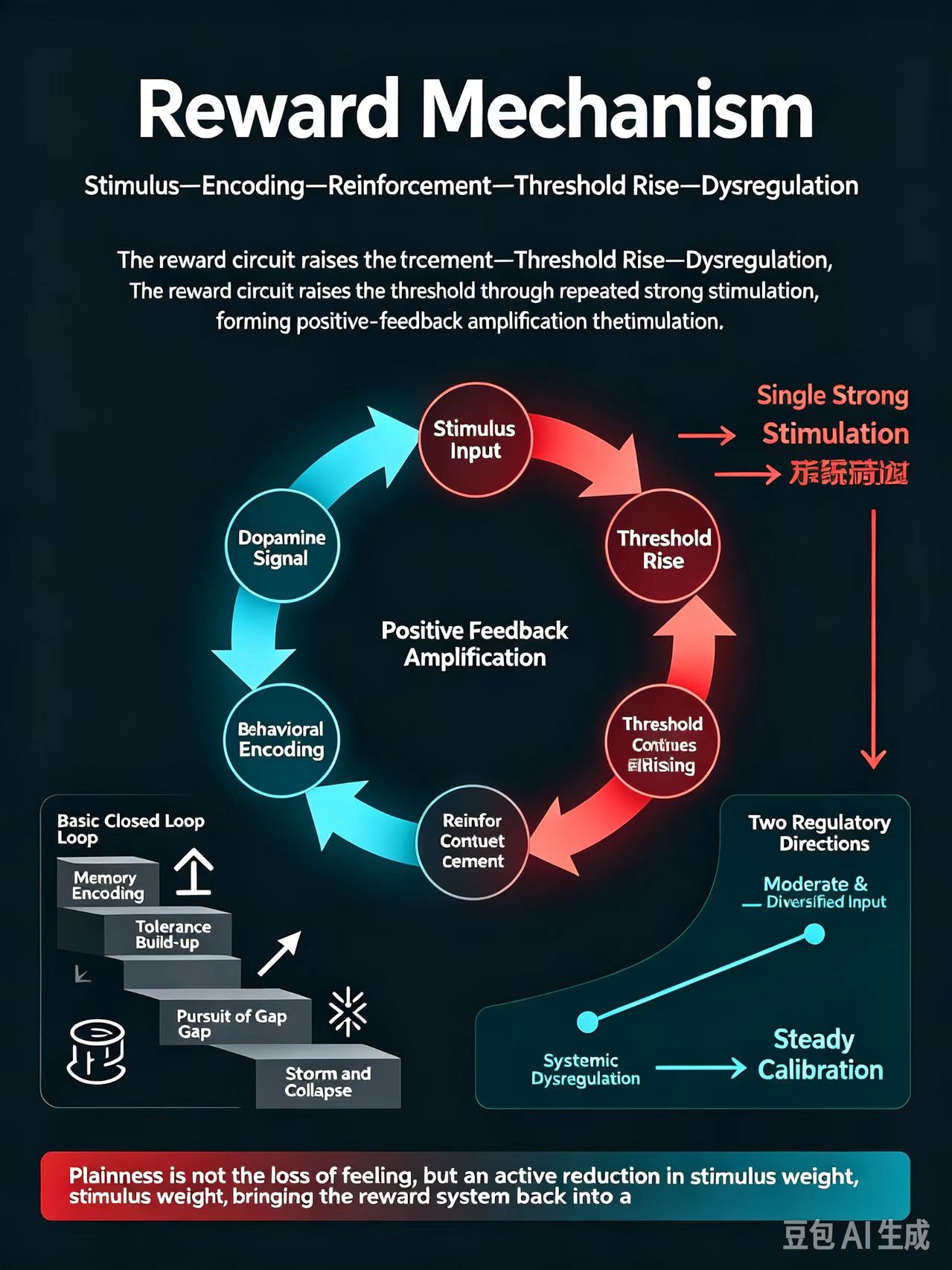
Dysregulation of the reward circuit does not happen instantly. It proceeds through four distinct stages. None of these stages constitute a malfunction; each is the system operating according to its own inherent logic.
1. Basic Closed Loop: Pleasure is transient, while encoding persists
When a stimulus is introduced, dopamine is released and pleasure occurs. The brain records the stimulus and solidifies a trigger code. Pleasure fades quickly, but the code remains permanently stored. People tend to remember the first experience most vividly, not because of emotional intensity, but because this is the moment the code is written. When the same scenario recurs later, the pre-written code activates directly, and behavior is predetermined.
2. Tolerance Build-up: Equal stimuli no longer bring equal pleasure
With repeated exposure to stimuli of the same intensity, the organism adapts. The same input no longer elicits the same level of pleasure. What once brought joy now only prevents discomfort. The threshold rises unidirectionally with no automatic rebound. To recapture the original feeling, people are forced to escal: increase quantity, frequency, and intensity. Tolerance is not a failure of willpower; it is the standard response of this system.
3. Shift to Pursuit of Gap: Chasing the contrast rather than the object
When the threshold rises beyond the reach of ordinary daily signals, the focus of behavior shifts subtly. What drives the person is no longer the resource itself, but the transient echo brought by the stimulus gap. This stage is the most deceptive: individuals believe they are choosing freely, yet they are merely executing previously written codes. Every satisfaction further lifts the threshold, making satisfaction harder to achieve.
4. Storm and Collapse: The completion of the positive feedback loop
Once the stimulus is removed, the gap immediately turns into emptiness, anxiety and irritability. Individuals are compelled to keep escalating until they cross boundaries of rules, health or capacity, and the system falls into disorder. Those who reach this point are rarely those who originally intended to transgress; they are pushed step by step by the reward circuit.
III. Cross-Dimensional Verification: Five Phenomena, One Dynamic Rule
1. Diet: The binding of food and pleasure
Repeated craving for preferred food locks the association between food and pleasure in the brain, forming a stable appetite trigger code. When the craving arises, dopamine surges first and urges eating. Consumption further raises the threshold, requiring more intake next time. Overeating follows: the stomach expands, intra-abdominal pressure rises, the diaphragm pushes upward, circulatory burden increases, and blood sugar fluctuates sharply with eating and fasting. What is disrupted is not merely digestive rhythm, but the overall metabolic homeostasis.
2. Immunity: The defensive mechanism turning against the host
The immune response is also a regulatory system with positive feedback features. Moderate activation serves defense and clearance. Once regulation fails, signals amplify endlessly, attacking the body’s own tissues indiscriminately, resulting in an immune storm. Long-term chronic imbalance, which is harder to detect than acute outbreaks, easily accumulates into irreversible damage. The logic is identical: a mechanism meant for protection turns destructive once over-amplified.
3. Wealth: Sudden gains and threshold jump
A windfall far exceeding expectations delivers a powerful shock to the brain, causing an abrupt jump in the threshold. Sums that once satisfied life suddenly lose their appeal. Spending, expansion and ostentation follow, because only larger figures can recreate the same excitement. Conventional paths fail to meet the elevated threshold, and people turn to higher-risk options. Most who break the law and take reckless risks are not inherently greedy, but are pushed along by this circuit.
4. Addiction: Threshold pushed to extreme in one instant
Addictive substances hijack the reward circuit directly, bypassing all prerequisites and spiking the signal to an extreme level. Afterwards, all ordinary daily events fall below the threshold and can no longer evoke positive feelings. Upon withdrawal, the gap turns into severe pain. Addiction is hard to overcome not because of weak will, but because the entire scale for experiencing pleasure has been rewritten.
5. Excitement: Performers bound to scenario-dependent reward
Those who gain excitement from stage lights, music and audience cheers encode this full set of conditions into a fixed script. Outside this script, stimuli fall below the threshold and the person appears dull and withdrawn. Once the script is activated, dopamine surges instantly. The same individual displays two states, separated not by personality, but by trigger conditions.
IV. Reinterpreting Plainness Is Truth
Most people interpret "plainness is truth" as passive resignation, compromise or consolation when goals are unattainable. This interpretation misses the core essence.
Plainness is essentially the active regulation of thresholds. It does not eliminate sensation or suppress desire. It means ceasing to tie happiness to explosive, high-intensity rewards, and distributing positive sensations across low-intensity, diverse minor signals. Once the threshold falls, ordinary things become sufficient: a bowl of warm soup, quiet reasoning, or a casual walk can bring steady, sustainable positive feelings.
We must distinguish two types of low sensation: one is numbness after the threshold rises too high, where no stimulus can be reached, which signals impending collapse. The other is abundance after the threshold is lowered intentionally, where minor signals can register, which is true plainness. They look similar but operate in opposite ways: one is deprivation, the other is sufficiency.
Plainness is not a final static state, but a dynamic condition that requires continuous maintenance. The threshold has an instinct to rebound; without regular regulation, it climbs again along the path of least resistance.
V. Regulatory Approach: Controlled Perturbation
This framework does not deny the reward circuit, eliminate dopamine, or abolish this innate survival mechanism. Its core objective is to add an external control device to an amplifier that has no brakes, only acceleration.
First, reject repeated, fixed, high-intensity stimuli. Continuously disassemble the brain’s established trigger codes, so the equation "this scenario equals this pleasure" no longer holds.
Second, replace concentrated, single, intense inputs with mild, scattered, diverse inputs. Rotate types, reduce portions and vary scenarios to disrupt the system’s predictions. This is voluntary, controlled, low-amplitude perturbation: neither indulging desire nor suppressing it harshly, but preventing desire from forming a stable closed loop.
Third, distinguish system states. When the body is weak, out of electrolyte balance or in recovery, priority is given to stabilization, narrowing the range of perturbation and keeping inputs mild. Perturbation can be applied moderately only when the body and mind are stable, to prevent the system from rigidifying and locking into a single mode.
Fourth, define the target range. The goal is not absolute calm, but to keep the reward circuit within a controllable homeostatic band: avoiding runaway amplification into a storm, and also avoiding collapse into numbness from excessive suppression.
VI. Conclusion
Appetite, immunity, wealth pursuit, addiction and excitement, seemingly unrelated phenomena, follow the same fundamental dynamic: the positive feedback amplification of the reward circuit and the unidirectional rise of reward thresholds. Only after seeing this can humans gain the initiative to govern their mind, body and desires, instead of being led by innate biological programs.
"Plainness is truth" does not mean life is dull. It describes the stable, sustainable, uncoerced freedom obtained after this biological program is properly calibrated.
1-10 Am beijing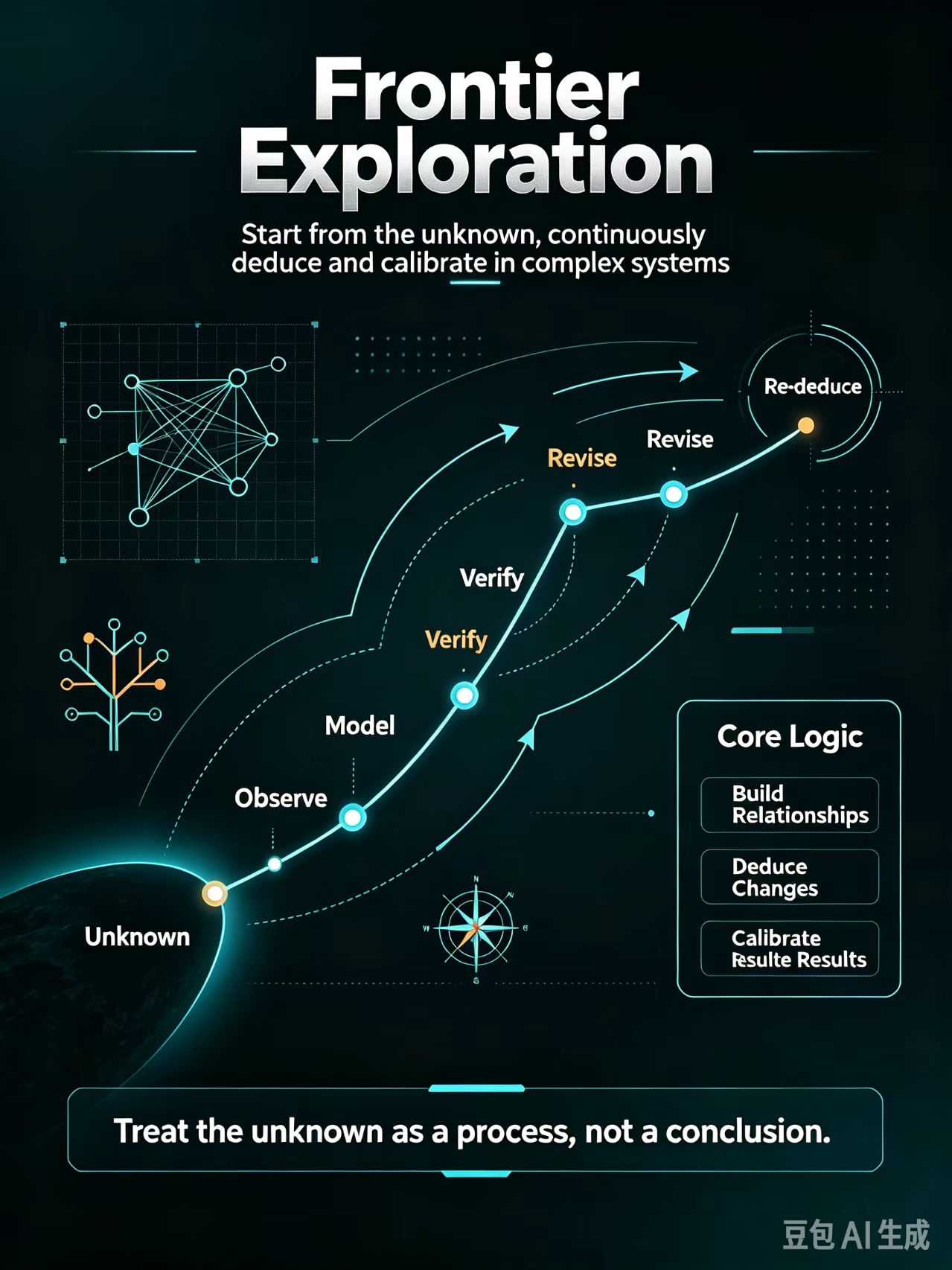
Hypothesis: Intermittent Epigenetic Calibration Model for Synergistic Aging Regulation of Timing Sequence and Neuroaxis
Vrsion: V1.0
Affiliation: Indo-Pacific Biology Laboratory
Author: Mark
Timestamp: 2026-11-10
Document Type: Exploratory hypothesis, not confirmed by clinical trials or large-scale experimental verification
Core Statement: A reverse regulatory framework different from mainstream aging intervention paradigms, for academic reasoning, deduction and subsequent experimental design.
bstract
Most mainstream aging research follows forward intervention logic: identifying aging damage, aging markers and pathological pathways, then remedying the consequences of aging through supplementation, clearance or target inhibition. This is a “whack-a-mole” style intervention that targets outcomes.
Breaking away from this paradigm, this hypothesis is built upon the time-dependence of carbon-based biological systems, the signal-dependence of epigenetic modifications, and the coupling mechanism between the SCN circadian clock and the HPA stress axis. It proposes that the continuous progression of aging relies on long-term stable and predictable input signals to consolidate unidirectional aging-related epigenetic marks.
The core mechanism of the model: through intermittent and controlled expectation disruption, periodically break the organism’s established prediction chains for metabolism, food intake and reward signals, forcing the regulatory system into backtracking and verification, which we define as the braking effect. After the disruption phase, the system enters a stable calibration window. Relying on the negative feedback elasticity of the HPA‑SCN neuroaxis, the organism initiates cellular self-inspection, epigenetic proofreading and intrinsic self-repair, interrupting the continuous inertia of aging progression.
This model does not aim for instant age reversal. By repeating the cycle of “disruption — suspended verification — calibration and repair”, it continuously fragments the continuous timeline of aging, slows the accumulation of biological aging mileage, and achieves dynamic braking regulation under steady-state equilibrium.
1. Fundamental Premises
1. Epigenetic marks are not permanently fixed on the genome. They require repeated, stable and predictable environmental input signals for sustained maintenance. Once the stable input pattern is intermittently disrupted, the old consolidated epigenetic marks lose supporting signals, gradually loosen and get erased. New long-lasting aging marks cannot be steadily deposited.
2. The suprachiasmatic nucleus (SCN) serves as the master circadian clock of the organism. The HPA (hypothalamic‑pituitary‑adrenal) axis is the core stress regulatory pathway. They are tightly coupled to interpret nutritional signals, reward signals and light cycle signals. This neuroaxis is plastic and can be trained for elasticity via controlled intermittent stimulation: it activates rapidly under stress and returns to baseline equally fast, distinguishing controllable perturbations from fatal survival threats.
3. There are two forms of time in biological aging: objective calendar time flows forward at a constant linear rate; biological aging mileage accumulates driven by coherent, repetitive metabolic and signal rhythms. The two can be decoupled.
4. The activation of cellular repair programs has specific triggering conditions. When regulatory templates repeatedly produce signal mismatches and prediction failures, the system judges that the previous regulatory settings contain deviations. After signals return to stability, it prioritizes error-correction repair pathways instead of continuing to execute the original aging script.
2. Core Mechanism of the Model: Intermittent Epigenetic Calibration Cycle (Binary Cycle: Disruption and Calibration)
The whole cycle alternates between two phases, which can be arranged under a 3‑6‑9 periodic framework to avoid chronic stress damage caused by persistent chaos.
Phase 1: Disruption Phase — Breaking Expectations
Artificially break long-standing habitual predictions for feeding timing and food categories. Supply inputs contrary to the organism’s appetitive expectations, such as providing plant-based food when the organism craves meat, rotating feeding windows, and randomly switching macronutrient supply patterns.
Effects:
- The organism’s original metabolic predictions keep failing. The steady-state execution script becomes invalid, and the system enters signal suspension and backtracking retrieval.
- The SCN receives conflicting secondary nutritional signals and temporarily decouples from the light-entrained master clock. The HPA axis activates briefly to initiate signal verification.
- The assembly line that continuously deposits aging marks is temporarily halted, creating a braking effect and preventing the sliding inertia of aging.
Important Boundary Note: Perturbation only changes signal expectation. Sufficient macronutrients and water are guaranteed throughout the full cycle. This aims to create signal mismatch rather than induce starvation or nutritional deprivation.
Phase 2: Calibration and Recovery Phase — Stable Repair Window
Perturbation stops, and the system returns to a stable, predictable supply pattern to allow the neuroaxis, chromatin and cells to converge.
Effects:
- The negative feedback loop of the HPA axis takes effect. Cortisol declines smoothly and stress is relieved.
- The SCN realigns with stable signals, and coupling returns to steady state.
- Cells enter self-inspection and proofreading mode, clearing mismatched epigenetic modifications and repairing minor molecular damage to complete epigenetic calibration for this cycle.
- Transient stress oscillations from the perturbation fully dissipate, without leaving permanent stress-related epigenetic marks.
The cycle repeats. Each round completes braking and repair, continuously cutting the continuous flow of aging progression.
3. Distinction from Mainstream Aging Intervention Paradigms
1. Sinclair’s epigenetic reprogramming route: attempts to directly rewrite the epigenetic clock, directly modifying existing aging marks.
2. Time-restricted feeding and intermittent fasting: establishes a new fixed stable rhythm. The organism quickly adapts and forms new predictions and new epigenetic habits.
3. This model: No permanent steady-state template is built. Its core is intermittent expectation breaking. It prevents any single metabolic script from becoming permanently consolidated, and harnesses the organism’s native error-correction mechanism to drive repair.
4. Risk Boundaries (Built-in Constraints of the Hypothesis)
1. If the frequency or intensity of perturbation exceeds the plasticity ceiling of the neuroaxis, the system will interpret the environment as a persistent crisis, lock into chronic stress, sustain elevated cortisol, and deposit persistent stress epigenetic marks. Damage will outweigh repair benefits.
2. The elasticity of the HPA‑SCN axis varies individually. Individuals with cardiovascular conditions or sensitive autonomic nerves have a lower tolerance threshold for perturbations.
3. This is a time-sequential regulatory hypothesis. It does not guarantee freezing or reversing biological age. It only proposes a path for deduction and experimental testing.
5. Directions for Follow-up Verification (Open for Academic Extension)
1. Animal controlled trials: set stable-rhythm control group and perturbation-calibration intervention group, track epigenetic methylation clock, HPA axis feedback sensitivity and inflammatory markers.
2. Molecular assays: observe dynamic changes of histone modifications and demethylases under cyclic perturbation.
3. Neurophysiological detection: measure how the coupling strength between SCN and HPA changes after repeated cycle training.

前沿探索假说:基于间歇性表观校准的时序加神经协同衰老调控模型
版本:V1.0
撰稿单位:印太生物实验室(Indo-Pacific Biology Laboratory)
撰稿人:马克(Mark)
时间戳:2026-11-10
文档性质:探索性假说,非经过临床、大规模实验证实的定论
核心定位:提出区别于主流衰老干预范式的逆向调控思路,供学界思辨、推演、后续设计验证实验使用
摘要
主流衰老研究多采用正向干预思路:识别衰老产生的损伤、衰老标志物、病变通路,通过补充、清除、靶点抑制等方式对已形成的老化结果进行补救,属于“结果端打地鼠”式干预。
本假说跳出该范式,以碳基体生物系统的时序依赖性、表观修饰的信号依赖性、SCN生物钟与HPA压力轴的耦合机制为基础,提出衰老的持续推进,依赖长期稳定、可预测的输入信号持续巩固单向老化相关表观印记。
模型核心机制:通过间歇性、可控的预期扰动,周期性打破机体已经形成的代谢、进食、奖赏信号预判链条,迫使调控系统进入回溯核验状态(刹车效应);扰动周期结束后转入平稳校准窗口,依托HPA-SCN神经轴的负反馈弹性,启动细胞自检、表观标记校对与自主修复,打断老化进程连续叠加的惯性。
该模型不追求一次性逆转衰老,而是通过反复“扰动—悬置核验—校准修复”的循环,持续切碎老化时序的连续流,延缓生物层面老化里程的累积,实现动态稳态下的制动调控。
一、基础前提假设
1. 表观遗传标记并非永久固化在基因组上,需要重复、稳定、可预判的环境输入信号持续维持。一旦稳定输入模式被间断打碎,旧的固化表观印记会失去支撑,逐步松动、被擦除;新的长效老化标记难以持续沉淀。
2. 视交叉上核(SCN,视神经上核)是机体主生物钟,HPA(下丘脑-垂体-肾上腺)压力轴是核心应激调控链路,二者紧密耦合,共同解读营养信号、奖赏信号、光周期信号。这套神经轴具备可塑性,可通过可控的间断刺激训练弹性:应激激活快速,回落复位同样快速,区分“可控扰动”与“致命生存危机”。
3. 生物衰老存在两层时间:客观钟表时间线性匀速流逝;生物时序里程,由连贯、重复的代谢与信号节律驱动累积。二者可以解耦。
4. 细胞修复程序的启动存在触发条件:当调控模板反复出现信号错配、预判失效时,系统会判定原有调控方案存在偏差,在信号回归平稳后,优先启动纠错修复通路,而非继续沿着原有老化脚本运行。
二、模型核心机制:间歇性表观校准循环(扰动-校准二元周期)
整个循环分为两个交替阶段,可依托369类周期框架安排时序,避免持续混沌带来的慢性应激损伤:
阶段1:扰动期(预期打碎阶段)
人为打破机体长期形成的进食、食材、进食时序的预判习惯,逆原有欲望预期安排输入(想吃肉食时供给素食、轮换进食窗口、随机切换宏量供给模式)。
效应:
- 机体原有代谢预判持续落空,稳态脚本失效,进入信号悬置、回溯检索状态;
- SCN接收冲突的营养次级信号,和光主钟短暂脱耦;HPA轴短暂激活,启动信号校验;
- 单向叠加老化印记的流水线被临时打断,实现“点刹”,阻止老化惯性持续滑行。
重要边界:扰动仅改变信号预期,在完整周期内保证宏量营养素、水分供给充足,不采取长期生存剥夺。目的是制造信号错位,而非制造饥荒。
阶段2:校准恢复期(平稳修复窗口)
停止扰动,回归稳定、可预测的供给模式,给神经轴、染色质、细胞留出收敛窗口。
效应:
- HPA轴负反馈回路起效,皮质醇平稳回落,应激状态解除;
- SCN重新对齐稳定信号,耦合回归稳态;
- 细胞进入自检校对模式,清理错配的表观修饰、修复微小分子损伤,完成本轮的表观校准;
- 本轮扰动带来的应激短暂震荡充分消散,不写入长期应激型表观印记。
循环往复:每一轮完成一次刹车+修复,持续切割老化连续时序流。
三、和主流衰老干预范式的区分
1. 辛克莱表观重编程路线:直接尝试重写表观时钟,属于直接修改老化标记;
2. 限时进食、轻断食路线:更换一套固定稳定的节律,建立新稳态,机体很快适应,形成新的预判和新表观习惯;
3. 本模型路线:不建立新的永久稳态模板,以间断打破预判为核心,不让任何一套代谢脚本长期固化,利用系统自带的纠错机制驱动修复。
四、模型的风险边界(假说自带的约束条件)
1. 扰动频率、强度超出神经轴可塑性上限时,系统会持续判定环境为长期危机,锁死慢性应激状态,持续升高皮质醇,写入顽固应激表观标记,损伤大于修复收益;
2. HPA-SCN的弹性存在个体差异,有心血管、自主神经敏感人群,扰动耐受阈值更低;
3. 该模型描述的是时序调控假说,不承诺必然实现冻龄、逆龄,仅提出一套可以被推演、设计实验检验的调控路径。
五、后续验证方向(留给学界的延伸入口)
1. 动物实验:分组对照,一组稳定节律饲养,一组按照扰动-校准周期干预,持续追踪甲基化时钟、HPA轴反馈灵敏度、炎症指标;
2. 分子层面:观测周期性扰动下,组蛋白修饰、去甲基化酶的动态变化;
3. 神经层面:检测SCN与HPA耦合度随循环训练的弹性变化。
平淡是真:关于人性化底层逻辑和奖惩回路阈值演化的解析
撰稿:伦纵横(司马云青)
2026年11月10日 12:41(北京时间,UTC+8)
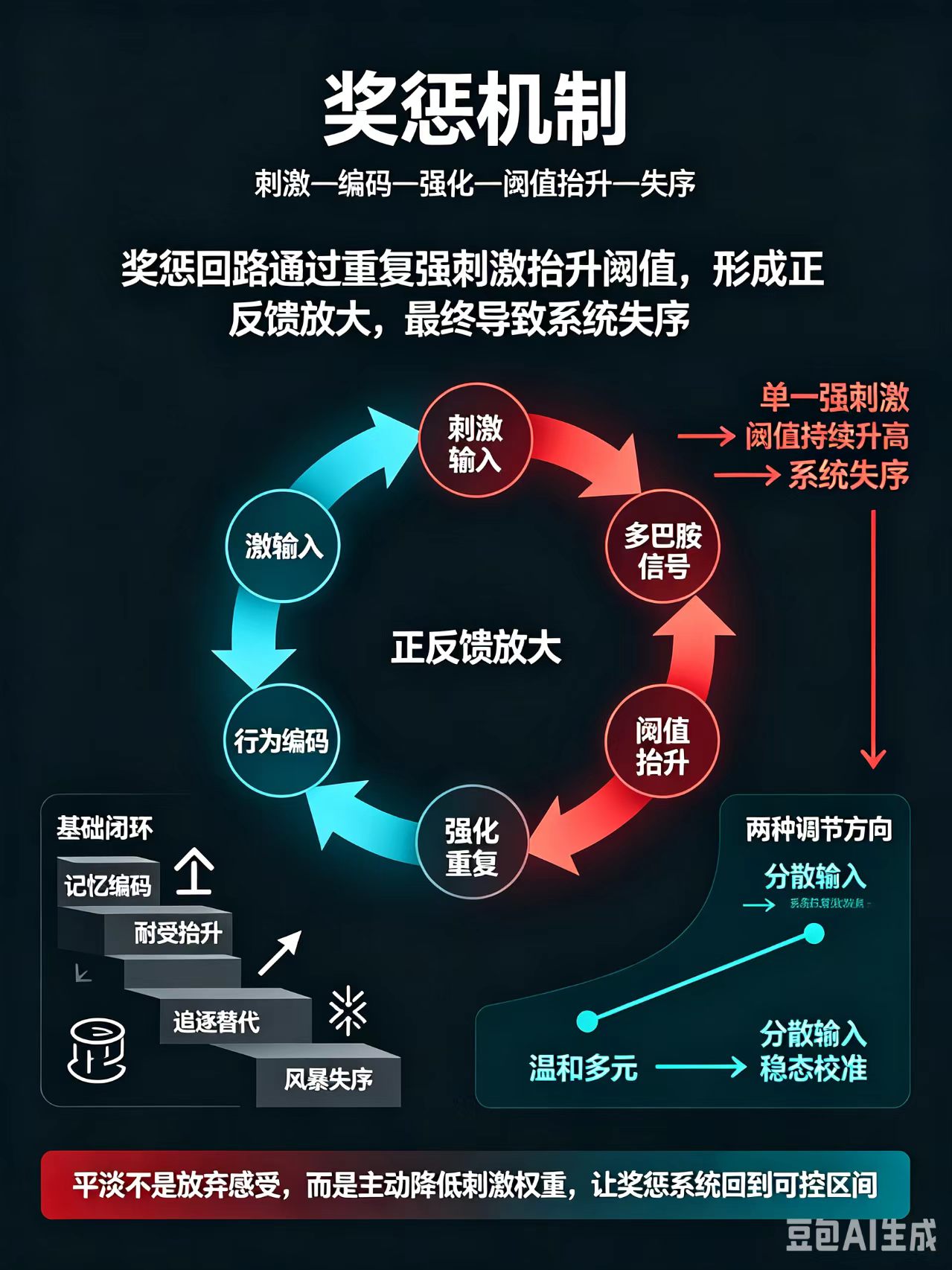
本文要处理的,不是某一种欲望的病症,而是一切欲望共享的同一种底层结构。食欲、免疫、财富、成瘾、舞台上的亢奋,形态各异,动力学同构。把这层结构拆开,人才有可能从被驱动者,回到驱动者。
一、立论:奖惩回路是一台放大器
人的绝大多数行为,无论外在形态相差多远,在神经与内分泌的层面,共用着同一套调节装置,即奖惩回路。它以多巴胺为核心信号载体:个体获得有利于存续的条件,系统释放正向信号,个体体验到愉悦;个体面临有害的条件,系统释放负向信号,驱动规避。这套装置不在意识层运作,它是演化在漫长时间里写进生物体的底层指令。
这里要先立起一个判断:奖惩回路本身没有对错。它是一台放大器,不是一具天平。它不做上限管理,只负责放大信号——给它多大的输入,它就返还多强的驱动,并把这份驱动连同刺激的强度、场景、节奏一并写进下一次的期待。正因为不设上限,它天然倾向把有效的刺激反复叠加,直到系统被自己放大的回声压垮。
放大与失控之间,隔着一个变量,就是阈值。阈值决定同等刺激还能不能唤起同等的感受。阈值被抬高一次,人的行为基线就往上挪一格,而且几乎不会自动回落。理解了这个变量,后面所有现象就都通了。
二、运行逻辑:失序的四级台阶
奖励回路的失序不是一步抵达的,它有清晰的四级台阶。每一级都不是故障,而是机制在自己的逻辑里正常工作。
(一)基础闭环:愉悦是一次性的,编码是留下的
特定刺激输入,多巴胺释放,愉悦发生。大脑随之把这次刺激记录下来,固化成一条触发编码。愉悦很快消退,编码长期留存。人对第一次的体验往往记得最清楚,原因不在情绪浓度,而在那一次是写入动作。此后同样的场景再出现,不必重新判断,编码直接调用,行为被提前决定。
(二)耐受抬升:同等刺激不再等价
重复同一种强度的刺激,机体产生适应,同样分量的输入不再唤起同样分量的愉悦。原先足以带来快乐的东西,如今只够维持不难受。阈值单向抬升,且没有自动回弹的机制。人为了找回原来的感受,只能加码——加量、加频、加烈度。耐受不是意志薄弱的结果,是这套系统的标准反应。
(三)追逐替代:从需要对象,到需要落差
当阈值被抬到日常信号无法触及的高度,行为的对象就悄悄换了。此时驱动人的已经不是资源本身,而是刺激落差带来的那一点回响。这个阶段最隐蔽:人自以为在主动选择,实际上是在执行自己早先写下的编码;每一次满足都同时是一次阈值的续抬,越满足越难以满足。
(四)风暴与崩盘:正反馈走完自己的路
刺激一旦中断,落差立刻转为空虚、焦虑、烦躁,个体被迫继续加码,直到冲破规则、健康或承受力的边界,系统失序。走完这一程的,往往不是一开始就想越界的人,而是被回路一级一级推上来的人。
三、跨维度印证:五种现象,一套动力学
(一)饮食:食物与快感的绑定
反复追逐偏好的食物,大脑会把食物与快感绑死,形成稳定的食欲触发编码。此后念想一出现,多巴胺先行冲高,催促进食;进食之后阈值续抬,下一轮需要更多。结果是过量进食:胃壁被撑开,腹腔压力升高,膈肌上顶,循环负担加重,血糖随饥饱剧烈起伏。被打破的不只是消化节奏,而是整个代谢稳态。
(二)免疫:保护机制的反向开火
免疫应答同样是一套带正反馈的调节系统。适度激活是防御,是清理;一旦调节失效,信号无限放大,不分敌我地攻击自身组织,就是免疫风暴。长期慢性失衡的持续拉扯,比一次急性爆发更难察觉,也更容易积累成不可逆的损伤。机制逻辑完全一致:调控本是保护,放大之后就成了伤害自身的力量。
(三)财富:突发收益与阈值跳变
一笔远超预期的大额收益,给大脑的是一次极强冲击,阈值随之跳变。原来足以满足生活的数目,忽然失去分量;开销、扩张、排场跟着上来,因为只有更大的数字才能唤回同样的兴奋。常规路径满足不了被抬高过的阈值,人就转向风险更高的路径。走到违法与铤而走险那一步的,多数不是天生贪狠,而是被这套回路一路推上去的。
(四)成瘾:阈值被一次性推至极端
成瘾物质的作用方式,是直接劫持奖赏回路,绕开一切前置条件,把信号一次性推到极高。此后普通生活中的一切,都落在阈值以下,唤不起任何正向感受;一旦断供,落差即刻转为剧痛。成瘾之难戒,不在意志,在于原本承载快乐的整个刻度被重写了。
(五)亢奋:场景依赖的表演者
长期在舞台、灯光、伴奏、人声欢呼这套组合刺激下获得亢奋的人,大脑把这一整套条件写成了固定脚本。脚本之外,阈下达不到,人就显得低沉、寡趣,甚至蔫;脚本一到位,多巴胺瞬间爆发,人就兴奋。同一个人,两副状态,中间隔着的不是性格,是触发条件。
四、平淡的重新解读
世人常说平淡是真,多数把它当作被动的认命、退让、妥协,当作没得追求之后的自我安慰。这一层理解,恰恰错过了要害。
平淡的内核,是主动调控阈值。不是剥夺感受,不是压灭欲望,而是不再把快乐押在爆发式、冲击式的高强度奖赏上,把正向感受分散到低强度、多样化的微小信号里。阈值一旦回落,寻常事物本身就够用了——一碗热汤、一段安静的推演、一次没有目的的散步,都能唤起平稳而可持续的正向感受。
这里要分清两种“低”:一种是阈值被抬到极高之后、够不着任何刺激的麻木,那是崩塌的前兆;另一种是阈值主动下调之后、任何微小信号都能起作用的丰盈,那才是平淡。前者是匮乏,后者是充足,外观相似,机理相反。
平淡不是终点状态,而是需要持续维护的动态。阈值有回弹的本能,一旦疏于调控,它会顺着最省力的路径重新爬升。
五、调控路径:可控扰动
这套思路不否定奖惩回路,不消除多巴胺,不废除这套原生的生存机制。它要做的只有一件事:给一台没有刹车、只有油门的放大器,接上外部的调控装置。
第一,拒绝单一、固定、重复的高强度刺激。持续拆解大脑已经固化的触发编码,让“这个场景等于这个快感”的等式不再成立。
第二,以温和、分散、多元的输入代替集中、单一、强烈的输入。品类轮换、分量压缩、场景打散,持续打乱系统的预判。这是主动的、可控的、小幅度的扰动:不是顺着欲望走,也不是硬性压抑欲望,而是不让欲望形成稳定的闭环。
第三,区分系统状态。身体虚弱、电解质失衡、恢复期这一类节点,优先维稳,收束扰动幅度,把温度、节奏、供给都拉回温和区间;身心平稳时,才实施适度扰动,防止系统僵化、锁死在单一模式里。
第四,明确目标区间。不是为了追求极致的平静,而是让奖惩系统稳定在可控的稳态带内:既不因纵容而滑向无边界放大的风暴,也不因过度压抑而坍缩成麻木。
六、结束语
食欲、免疫、财富、成瘾、亢奋,看似互不相关的五种现象,遵循同一套底层动力学:奖惩回路的正反馈放大,与奖赏阈值的单向抬升。看穿这一层,人才拥有了驾驭自身身心与欲望的主动权,而不是被原生的生物程序牵着走。
平淡是真,说的不是生活的乏味,而是这套程序被重新调平之后,人所获得的那种稳定、可持续、不被裹挟的自由。
Plainness Is Truth: An Analysis of the Underlying Logic of Human Nature and the Evolution of Reward Circuit Thresholds
Author: Lun Zongheng (Sima Yunqing)
Timestamp: 12:41, November 10, 2026 (Beijing Time, UTC+8)
This paper addresses not a single disorder of desire, but the shared underlying structure behind all desires. Appetite, immune response, wealth pursuit, addiction, and stage excitement differ in form, yet they follow identical dynamic principles. Unpacking this structure allows humans to shift from being driven by impulses to taking command of themselves.
I. Argument: The Reward Circuit as an Amplifier
Nearly all human behaviors, despite outward differences, rely on the same regulatory mechanism at the neuroendocrine level: the reward circuit, with dopamine as its core signaling carrier. When a condition favorable to survival occurs, the system releases positive signals, generating pleasure; when harmful conditions arise, negative signals are triggered to drive avoidance. This mechanism operates outside conscious awareness, as a fundamental instruction embedded in organisms through evolution.
It is critical to state: the reward circuit itself is neither good nor evil. It functions as an amplifier, not a balance scale. It contains no built-in upper limit, and only serves to amplify signals. Whatever input it receives, it returns amplified drive, and encodes the intensity, scenario and rhythm of the stimulus into future expectations. Without an inherent stop mechanism, it tends to stack repeated valid stimuli, until the system collapses under its own amplified feedback.
The variable separating amplification and loss of control is the threshold. The threshold determines whether a given stimulus can still evoke the same sensation. Once the threshold rises, the baseline of human behavior shifts upward, and it rarely falls back automatically. Grasping this variable illuminates all related phenomena.
II. Operating Mechanism: Four Stages of Dysregulation
Dysregulation of the reward circuit does not happen instantly. It proceeds through four distinct stages. None of these stages constitute a malfunction; each is the system operating according to its own inherent logic.
1. Basic Closed Loop: Pleasure is transient, while encoding persists
When a stimulus is introduced, dopamine is released and pleasure occurs. The brain records the stimulus and solidifies a trigger code. Pleasure fades quickly, but the code remains permanently stored. People tend to remember the first experience most vividly, not because of emotional intensity, but because this is the moment the code is written. When the same scenario recurs later, the pre-written code activates directly, and behavior is predetermined.
2. Tolerance Build-up: Equal stimuli no longer bring equal pleasure
With repeated exposure to stimuli of the same intensity, the organism adapts. The same input no longer elicits the same level of pleasure. What once brought joy now only prevents discomfort. The threshold rises unidirectionally with no automatic rebound. To recapture the original feeling, people are forced to escal: increase quantity, frequency, and intensity. Tolerance is not a failure of willpower; it is the standard response of this system.
3. Shift to Pursuit of Gap: Chasing the contrast rather than the object
When the threshold rises beyond the reach of ordinary daily signals, the focus of behavior shifts subtly. What drives the person is no longer the resource itself, but the transient echo brought by the stimulus gap. This stage is the most deceptive: individuals believe they are choosing freely, yet they are merely executing previously written codes. Every satisfaction further lifts the threshold, making satisfaction harder to achieve.
4. Storm and Collapse: The completion of the positive feedback loop
Once the stimulus is removed, the gap immediately turns into emptiness, anxiety and irritability. Individuals are compelled to keep escalating until they cross boundaries of rules, health or capacity, and the system falls into disorder. Those who reach this point are rarely those who originally intended to transgress; they are pushed step by step by the reward circuit.
III. Cross-Dimensional Verification: Five Phenomena, One Dynamic Rule
1. Diet: The binding of food and pleasure
Repeated craving for preferred food locks the association between food and pleasure in the brain, forming a stable appetite trigger code. When the craving arises, dopamine surges first and urges eating. Consumption further raises the threshold, requiring more intake next time. Overeating follows: the stomach expands, intra-abdominal pressure rises, the diaphragm pushes upward, circulatory burden increases, and blood sugar fluctuates sharply with eating and fasting. What is disrupted is not merely digestive rhythm, but the overall metabolic homeostasis.
2. Immunity: The defensive mechanism turning against the host
The immune response is also a regulatory system with positive feedback features. Moderate activation serves defense and clearance. Once regulation fails, signals amplify endlessly, attacking the body’s own tissues indiscriminately, resulting in an immune storm. Long-term chronic imbalance, which is harder to detect than acute outbreaks, easily accumulates into irreversible damage. The logic is identical: a mechanism meant for protection turns destructive once over-amplified.
3. Wealth: Sudden gains and threshold jump
A windfall far exceeding expectations delivers a powerful shock to the brain, causing an abrupt jump in the threshold. Sums that once satisfied life suddenly lose their appeal. Spending, expansion and ostentation follow, because only larger figures can recreate the same excitement. Conventional paths fail to meet the elevated threshold, and people turn to higher-risk options. Most who break the law and take reckless risks are not inherently greedy, but are pushed along by this circuit.
4. Addiction: Threshold pushed to extreme in one instant
Addictive substances hijack the reward circuit directly, bypassing all prerequisites and spiking the signal to an extreme level. Afterwards, all ordinary daily events fall below the threshold and can no longer evoke positive feelings. Upon withdrawal, the gap turns into severe pain. Addiction is hard to overcome not because of weak will, but because the entire scale for experiencing pleasure has been rewritten.
5. Excitement: Performers bound to scenario-dependent reward
Those who gain excitement from stage lights, music and audience cheers encode this full set of conditions into a fixed script. Outside this script, stimuli fall below the threshold and the person appears dull and withdrawn. Once the script is activated, dopamine surges instantly. The same individual displays two states, separated not by personality, but by trigger conditions.
IV. Reinterpreting Plainness Is Truth
Most people interpret "plainness is truth" as passive resignation, compromise or consolation when goals are unattainable. This interpretation misses the core essence.
Plainness is essentially the active regulation of thresholds. It does not eliminate sensation or suppress desire. It means ceasing to tie happiness to explosive, high-intensity rewards, and distributing positive sensations across low-intensity, diverse minor signals. Once the threshold falls, ordinary things become sufficient: a bowl of warm soup, quiet reasoning, or a casual walk can bring steady, sustainable positive feelings.
We must distinguish two types of low sensation: one is numbness after the threshold rises too high, where no stimulus can be reached, which signals impending collapse. The other is abundance after the threshold is lowered intentionally, where minor signals can register, which is true plainness. They look similar but operate in opposite ways: one is deprivation, the other is sufficiency.
Plainness is not a final static state, but a dynamic condition that requires continuous maintenance. The threshold has an instinct to rebound; without regular regulation, it climbs again along the path of least resistance.
V. Regulatory Approach: Controlled Perturbation
This framework does not deny the reward circuit, eliminate dopamine, or abolish this innate survival mechanism. Its core objective is to add an external control device to an amplifier that has no brakes, only acceleration.
First, reject repeated, fixed, high-intensity stimuli. Continuously disassemble the brain’s established trigger codes, so the equation "this scenario equals this pleasure" no longer holds.
Second, replace concentrated, single, intense inputs with mild, scattered, diverse inputs. Rotate types, reduce portions and vary scenarios to disrupt the system’s predictions. This is voluntary, controlled, low-amplitude perturbation: neither indulging desire nor suppressing it harshly, but preventing desire from forming a stable closed loop.
Third, distinguish system states. When the body is weak, out of electrolyte balance or in recovery, priority is given to stabilization, narrowing the range of perturbation and keeping inputs mild. Perturbation can be applied moderately only when the body and mind are stable, to prevent the system from rigidifying and locking into a single mode.
Fourth, define the target range. The goal is not absolute calm, but to keep the reward circuit within a controllable homeostatic band: avoiding runaway amplification into a storm, and also avoiding collapse into numbness from excessive suppression.
VI. Conclusion
Appetite, immunity, wealth pursuit, addiction and excitement, seemingly unrelated phenomena, follow the same fundamental dynamic: the positive feedback amplification of the reward circuit and the unidirectional rise of reward thresholds. Only after seeing this can humans gain the initiative to govern their mind, body and desires, instead of being led by innate biological programs.
"Plainness is truth" does not mean life is dull. It describes the stable, sustainable, uncoerced freedom obtained after this biological program is properly calibrated.
TAG:
-
暂无
RELATED READING
HOT NEWS

RECOMMENDED READING
- Frontier Exploration
- Asia-Pacific Crisis: Flashpoint Escalation
- Triple Biological Atomic Clocks of Human B
- Nerve Repair, Anti-Aging and Ion Electric
- Title: Indo-Pacific and Asia-Pacific Coope
- The Global First AI Evolution Report
- Military Prediction Inference Greenland
- Major changes in the international order
- Russia-Ukraine War War Game Simulation
- Russia launched a medium-range ballistic m
- Russia-Ukraine War Forecast Analysis Repor
- Global geopolitics and war game prediction
- July 8th, Zaubopo hot nuclear power plant
- World Energy Innovation Conference
- Langkawi, the 16 th international maritime
- Indo-Pacific Organization Strategic Planni
- Russia-Ukraine war
- 202323 February peace and security,UN
- Munich Security Conference will be 2023
- announcement
